Sunday, April 8, 2007


2006 TP52 Globals - March 2006

So I will try to blast out three posts this week before I head for Palma Vela to set a baseline for my future writing. Today I will focus on the 2006 TP52 Globals and my experience sailing on the Gen 1 NM TP52, then later this week on Sardinia Cup and the Med focused B&C TP52s, and then a report with some general thoughts on this summer’s sailing.

Generation 1 Meets 2006

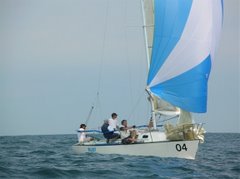
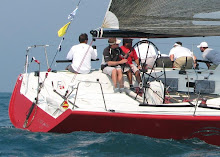
So to start with, Glory and the other generation 1 TP52s were designed specifically for the Transpac Race to Hawaii and racing down to Mexico. The design criteria stated that they should be lightweight and simple, with maximum headroom below decks. Glory/Yassou, Rosebud, Lightwave, and Flash all fall into the first generation of TP52s and when we arrived at the docks in Miami the differences between what we were sailing, and what the top teams were sailing, was quite stark (see above photo to illustrate the differences).

So the 2006 Globals started inauspiciously with us continuing to rig the boat and looking at our brand new Quantum sails on the way to the racecourse. What was a slow start gained momentum as we generally improved our gap to the top 3 boats in the inshore races from roughly 3 minutes behind to as little as 15 seconds by the end of the week. Overall I think that we could attribute a lot of that to getting use to the new modifications, improved boat-handling and a doing a better job of shifting gears downwind (between a more aggressive reaching mode or digging deep).

Observation 1: While the 2003 Glory was fast upwind/downwind with her new facelift, we continued to suffer from reduced form stability uphill, and we gave away a lot power reaching to the newer designs which sported much wider transoms. Additionally, we were a much different boat when it came to weight of hull and bulb and internal ballast. During the 12 months that we sailed this boat, we affectionately called Glory “the cruise-liner” because of her especially stout build, and we were amazed to see how light (and few ring frames) many of new builds had just 2 years later (driven by the Med conditions/designs). Despite the extra weight in the hull we were quick enough around the track, and especially later in the regatta we were often able to hold our own inshore against the newer designs such as the 2005 Farrs. When the Nelson 52 was sold to a new owners in Australia, we felt that we had really spent a lot of time getting the most out of the boat and that the design changes were worth it - especially when she went on to nearly win her class in the Sydney Hobart as WotYot.

Observation 2: Crew work/systems at this level is very refined – Well no kidding, anyone would all expect this but having started from scratch with the 2003 systems, we saw exponential improvement as we changed or upgraded. When designed, the sail handling systems for the generation 1 boats were designed to use one pedestal to drive the primaries, with drive shafts above deck for extra headroom below. They were set up with two halyard winches, two primaries linked to a single pedestal, two mainsheet winches with a full 2:1 German Admiral's Cup dedicated winch mainsheet system and then a set of secondary winches for in-line changes and peels (which we removed in the refit). This is a decent all-around system, but short on horsepower when compared with the latest generation bots when jibing and in prestart maneuvers. As time went by this proved less then optimal for round the cans racing and If I was going to single out one change that made the boat easier to sail – it would have to be the overdrive gears on the primaries. When we started jibing Glory we were taking around 18 seconds from initiating the jibe, furling the staysail, jibing the pole (disconnect and running it back until it cleared the hoisted staysail) and then completing the jibe, and unfurling. Over the course of the Globals we reduced that time to 8-11 seconds simply by changing technique for moving the pole and use of overdrive gearing.

Even with multiple pedestals linked together, the maximum power (according to Harken) a human can generate is 200rpm. That equates to a winch line speed of 94m/min. With the first gear of 1:1, the line speed is still too slow to get these big asymmetric around efficiently – the overdrive kit accelerates the winch by 2.4 times (Gear Ratio of 1:2.4). Now the overdrive turns the winch in first gear (1:1) and in overdrive (1:2.4), 1 turn of the handle generates 2.4 turns of the winch drum. This equates to a line speed of 225m/min. This means that you have to move quick keep up with the grinders as the rope is spit from the winch on the jibes - this is now a must have for asymmetrical kites (even the GP42 are sprouting pedestals) to get the kite around at blazing speeds.

Additionally while many of the 2005/2006 boats had two pedestals we only had a single one – so getting the main across in jibes was painful. Key through the jibes, was for our trimmers to be top-handling the guys back in addition to use of the pedestal (which is less than efficient). While the grinders were pulling the kite around in overdrive, they were also trying to muscle the guy back and relying on the offside trimmer to be on a handle to keep from bogging down mid-jibe. The 2005 and newer systems, and the new system on Glory, are able to lock all the pedestals (4 grinders) together to bring across the main, pull the kite around and the pole back at the same time. Additionally the majority of the boats this year will be using a pedestal to drive the cabin top winch to hoist the kite halyard (aiding in speed and smoothness).

Side Note:

One aspect of the TP52 class is that it requires distance racing in major events. Now I have never been a fan of offshore/distances racing since most of my memories are of slogging upwind on paper-thin one-tonners, through the night, riding the rail in the bow position. However, the distance race at the Globals had to be one of the most fun experiences of my sailing career as we crossed the Gulf Stream twice and were rewarded with blasting back from the Bahamas, at night, surfing at sustained high-teens and low-twenties under a near full moon. Bruce Nelson positioned us correctly on the first beat allowing us to round as one of the top three and then we spent the rest of the night chasing Beau Geste and the generation 3 Farr designs, while holding off Pegasus (who only just passed us an hour or so before the finish).

Later this week – Racing the Med TP52s in Italy

Friday, April 6, 2007


So how did Team Glory come together and what is our outlook for the 2007 Med Cup?

Over the last 18 months I started bumping into old friends while on the sailing circuit who wanted to know what was going on with the TP52 Glory and what it was like trying to get a boat and team to the Med Cup. Well, with Tac’s help I hope to consolidate all those mails and just blog a couple times a week, starting today, and ending at the TP 52 Globals in September. Now I am far from an expert on the pro sailing scene but friends have commented that my observations over the last 18 months have provided some good insight for those of us not getting paid to race.

Well preparation for the 2007 MedCup began in November of 2005 when John purchased a 2003 generation TP52 (Yassou) and immediately sent her to be modified to be as competitive as possible with the 2006 fleet at the Global Championships. While Yassou was under the knife, Team Glory chartered the 2005 Med Cup runner-up (2005 Farr TP52) and raced it in howling conditions at Key West Race Week. All I will say about this experience is that this is when the team decided we would never race a Med TP52 off shore without a significant work-up (and led to many protracted discussions on the merit of bow ring-frames). Any future Glory would be built with provisions that would ensure that it would be able to get to Hawaii and back.

After 5 weeks of non-stop work by Goetz Boatworks (www.goetzboats.com) Glory emerged from the shed with a new bow and stern (designed by Bruce Nelson), reworked foil and significantly stiffened spar. After a few days of ticking off critical jobs on the boat we put on the new sail inventory by Quantum and hit the water. As our first class event, we did not find our stride at the Globals until midway through the event, but better late than never. The bright point was that our team gelled and had led the offshore race and last two inshore races of the series.

Based on the promising performance in the Global Championships, we were invited to compete at the Rolex World Team Race Championships in Sardinia, Italy. After rushing Glory back to the Pacific Northwest to compete in the Swiftsure Offshore Classic Yacht Race (which we won overall) we jumped a flight to Europe to represent the United States in the TP52 class. Team Glory sailed a B&C TP52 under sponsorship of WOKITA.com, Gaastra, Balearia and Deporte Galego but unfortunately struggled with acclimating to the boat, the sails and the racecourse after losing 3+ days of practice to weather and broken equipment.

Although we are focused on running a Corinthian effort this year, it absolutely does not mean that we are going to a gunfight unarmed. Our team is primarily NW based with the addition of two sailors from Australia and Spain and includes Olympic sailing medals, World, North American, and US National Championships and Hobart, SORC and Key West winners.

Overall Team Glory expects to contend for individual race and event wins and compete for the season’s overall Corinthian trophy.

Next – Observations and insights from the TP Globals and Sardinia Cup.

Wednesday, April 4, 2007

Special Guest Star


Over the next few weeks, a good buddy of mine will be posting on this blog. Paul Andrepont used to work for the family back in the day and is quite a good sailor. Paul now lives out in Seattle where he has been sailing with the Buchan Racing team on various racers named Glory. In the last 18 months Team Glory has been involved in some really cool racing. The owner bought Yassou the NM Transpac 52 and totally modified it to make it competitive with the new boats. Glory sailed the 2006 Transpac 52 Intergalactics and finished quite well considering age of the boat and the relative lack of big boat experience.

Glory then chartered another TP 52 for an event in the med last summer and at that point the owner John Buchan decided to build a new boat for the 2007 season. They quickly settle on JV and built the 3rd boat out of the Mean Machine Mold at Hakes Marine. Mean Machine for those who do not know won the entire MEDCUP season last year!

Anyway the team is quite serious about making a run at the MEDCUP this season and in doing so have crossed trained in the MUMM 30 fleet, sailing the Worlds and also in the Farr 40, having bought the former Mean Machine Farr 40.

They have built a beautiful new TP 52 that is about to make her debut at the Palma Vela regatta over the next couple weeks. Paul will be doing some blogging from the event on the trials and tribulations of ramping up a brand new TP 52 against some of the top finishers last season. Looking at the entry list, I see Mean Machine will be there so they will have their full.

Team Glory are a bunch of good dudes and are putting a full 100% effort into winning the 2007 MEDCUP. I look forward to reading what Paul has to say as much as the rest of you.

Good luck to Glory for the 2007 Season.
Cheers

Tac