Wednesday, May 2, 2007

Annapolis NOOD continued.


After flying home for a few days of work between our practice weekend and the regatta, we arrived to once again find very little wind. We arrived down at the boat around 8:30 AM and found the parking lot about empty? That kind of surprised us as we were anticipating the lot to be full of activity and we were hoping for some tuning partners.

We quickly launched anyway and left the dock to get some practice in, we still needed to work on tacking and dousing. We also wanted to look at the new mainsail that was just delivered. We again headed over towards the Navy's yacht yard and found two marks that we could sail between and started doing laps. Things were going very well and we had improved and things were looking good.

The morning breeze started to die after about an hour so we headed back to the dock and over to the Boat Yard again for lunch. After some good food we heading back to the dry sail lot and tried to find a dance partner for the afternoon. We finally got Curtis Florence and Suzie Wulff on the water to sail against us. As most know I have sailed more miles with Curtis then either of wish to admit, we have won many many races with each other. This is Curtis' first foray in boat ownership! C and S were quite smart in choosing Bill Abbott Jr. to drive Devil's Play for them.

So out we go and line up against another boat for the first time! We were quite happy as we had some great speed against them and pretty much controlled the tuning. It was nice to match up against them. Bill told us the boat looked great sailing the through the water and was very balanced looking. I have to agree, I really felt good about how we were going.

Devil's Play was having some winch issues, this was their first day on the water as well. C and S had bought this boat about 4 weeks before this event. So off to the dock and of course back to the Boat Yard!

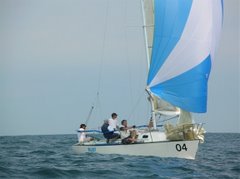
Race Day #1, or should I say rain and no wind day #1! Nothing to report, other then the picture above.

Race Day #2, again the day arrived and the wind was nowhere to find. We sat out on the course for some time before the breeze finally came up and we were able to get some races off. In the first race, I had a shocker of a start, not a great first beat but on the run we were quite special. We passed about 7 boats on the run, by finding a bit of breeze down the middle and quite a good bit of pace. We continued to chip away at the fleet and ended the first race with a nice solid 6th place. (Of course out tuning partner ended up winning the race!)

Race 2 again saw a horrible start on my part, I was surprised how off my timing was on this boat. When I thought I was 1/2 lane off the line and the guy 1-1/5 boat lengths ahead was over, I was actually way late and he was perfect? So I need to work on this as well. We sailed OK this race, it was light and shifty and we missed a couple shifts up the first leg and again passed some boats downwind. We finished 16th. Not real bad but not where we felt we should have been.

Race 3, I do not remember! Must be the placing of 21 that causes temporary memory loss :)

We finished the day in 15th place about 7 points out of 11th. We were OK with that, we were knocking on the door of the top 10 and still had a day to go.

Sunday came with the breeze! What had been taking us an hour to sail to the course was taking like 15 mins, so we ended up out there really early. We took the sails down and just drifted around, watching the breeze and watching some of the boats that were sailing. We kind of formulated a plan and then after a hour of just watching we tuned the rig, raised the sails and went sailing.

The boat felt awesome! This was the first time we had sailed in any breeze at all and it was very very cool. We had some great wheels and make our race plan. Because I was starting so badly I decided to just play up near the boat so that I would have an escape if needed. Well I got a better start and was able to sail for a good hunk of time in clear air. We did want to get to the right so we tacked out and stuck to our plan. We sailed very well in this race and had great upwind speed, our downwind was not as good as we actually got passed by a couple boats. We were as high as 6th but finished with a 9th.

The last race of the regatta saw our best start. I could not believe the lane that I had! We were launched about mid way up the line and going very fast. Just about 2 mins after the start a big right shift came in and allowed Pete McChensey to leverage into a great spot on me and I could not live so we had to tack out. We sailed up the first 2/3 of the beat in the top 10 again. As we approached the top mark, we had three bad tacks in a row and got flushed out the back. This race was very disappointing as the wheels kind of came off. We lost a bunch of boats right at the finished and ended up with a 23rd.

That put us in 17th for the event, 4 points out of 13th. Not too bad, we accomplished our goal of a top half finished, but left us all disappointed because a much better result was easily achievable.

The team will get better and the results will improve. The most important thing was that Roger and Ned had a great weekend and had a ton of fun. Till next time

Tac

Tuesday, May 1, 2007

Preparation for the Annapolis NOOD

Ned Goodman, the happy owner!

So after several months of waiting and planning we finally arrived in Annapolis, the weekend before the event, to rig, practice and prepare for the NOOD regatta.

The boat was all that Scott said it would be! It has some cool little tricks that make sailing it easier and the bottom is just sweet. It really shows that the extra money up front gave us a much better boat then we were originally looking at.

As mentioned we flew in the weekend before the event to get the boat rigged, prep'ed and to sail it for the first time. This gave us a chance to apply a new type of "speed spooge" that I had not used yet. We applied the Holmenkol Sport Polish to clean the top sides and then applied the Aqua Speed process over that. It is very easy to apply the two coats needed and the result was quite impressive. (when we watched boats get pulled in front of us at the end of the regatta, they had a lot more cleaning to do then we did. All we needed to do was hose the boat off and it cleaned right up!)

Saturday brought light winds but just enough to go out and put a few laps around the fixed bouys. It was good to get the boat around the "race course" to see what we needed to do to improve. We broke the first session down during a great lunch at the Boat Yard and went back out to focus on those aspects that needed work. It was even lighter then in the morning so we only did a lap or two and then sailed in. What we learned we needed to work on was 1) tacking, I was doing a horrible job of getting the tacked. We needed Roger to hold the Jib back winded longer during the tack as well. This helps the boat roll and brings the bow down on the new board with less rudder movement from me. 2) Our douses needed serious work.

By the end of sailing on Saturday I was pretty convinced that I had never driven a boat before :) I was really surprised at how different the mechanics of tacking the 22 are compared to boats like the S2 7.9. For those who are not familar with the 22, the driver sits well forward of the traveler and all the controls are lead up to that position. So in a tack you need to roll the boat, work the traveler and of course get back behind the traveler, get to the new windward side and then move forward. It took me a while!

Sunday was again light and we worked very hard at getting the issues settled. We again found a couple marks that lined up and sailed a ton of ups and downs. We slowly started to get our douses figured and with each one they got better. The same was going for our tacks. I was still not doing them perfect but I was at least getting the hang of them. Roger sorting out the proper amount of back wind in the jib was a big key in that.

We started to notice that we were doing some things very well for a new team. Our sets were awesome. We quickly did a couple things that helps us with the sets. We put a mark on the spinnaker sheet at a point that if we cleat at that point on the beat, we can set the kite and the mark pre-sheets the sail in and allows the kite to fill.

Our grasp of where and when to sit in certain positions for boat feel and heel was quite good as well. We were starting to figure out how the boat liked to sailed, mind you that was with out even sailing against another boat! Our gybes we very good, I was convinced that Ned lied when he said he had never done bow before.

As Sunday ended and we needed to head to BWI for flights home, I was very happy with the base that we had laid down. I was confident that we would continue to improve tacking and dousing and we would be at least competent when the racing starting. Now who knew at this point whether we would be fast or not, that would have to wait till Thursday.

I will post more tomorrow on the actual regatta.
Cheers

Tac.

Thursday, April 12, 2007


2006 World Team Race World Championships (Sardinia Cup) - Trans Pac 52 Med Style

I have always enjoyed racing box rule boats, IOR One-tons, IOR 50s, ILC 40s, MORC Maxis, it just doesn’t matter, I personally enjoy seeing the advancement of the box rule, so that fact that the TP52s that race in the Med appear to be distant cousins to the first generation of boats matters little to me. In the end the Sardinia Cup was a great opportunity for our team to trial one of the B&C designs built specifically for the Med, and for our owner to see if this is where he wanted to spend his sailing budget.

Trans Pac 52s in the Mediterranean

As I indicated last week, based on our promising performance in the Global Championships, we were invited to compete at the Rolex World Team Race Championships in Sardinia, Italy. Glory sailed a B&C TP52 under sponsorship of WOKITA.com, Gaastra, Balearia and Deporte Galego and I think that most of the team would agree that this boat held little in common with what we had been sailing. The evolution of the TP 52s for the Med began just after the Farr Gen 3 boats came out and while the Mediterranean IMS fleet was looking for the next stable rule (while the IMS 600 raters were quickly designing themselves to their death). Driven by a commitment from many of the principal IMS players including the King of Spain the feet had its first events with roughly 12 boats including Pisco Sour, Orlanda, and Balearia from B&C and Caixa Galicia, Atalanti, Bribon, from Farr and then the US Farr Gen 3 boats represented by Bambakou and Siemens (Sjambok). In the 2006 Sardinia Cup we sailed one of the 2005 B&C designs that were known for their high form stability, very thin keel section and the need to have their bow down to perform well. We struggled acclimating to this package in the short time we had available to get tuned, but it was good to see what designs were where in the design spectrum before looking to select a designer for 2007.

In 2006 the fleet grew to roughly 22 including new designs from B&C, Farr, Brenta, and the series winner (Mutua Madrilena MM) from Rolf Vrolijk. From 2005 to 2006 the fleet evolved dramatically from going fast in a straight line (I am oversimplifying here) to much more focus on holding a line upwind (since the fleet doubled in size) and keel and hull shape changes bore this out. However a strong showing from the 2005 Siemens (Patches – 2006 Globals winner) and continued bursts of speed from the 2005 B&C and Farr designs, it showed that you did not need the newest boat to win races.

It will be interesting to see what happens in 2007 as the level is upped even further than MM pushed it in 2006 and if the fleet can continue its rapid growth with a rumored 25 boats ready for 2007 and nine new teams hitting the water. However, 2007 will be critical year as the fleet appears to be hitting a plateau with key team such as Orlanda (2005), Atalanti (2006) and Rush (2006) appearing not to be returning this summer.

Observation 1: Spars - The standard for many years were two-spreadered Hall spars. Last year we used two different generations of the Hall spars and became quite familiar with tuning it but after attending the Sardinia Cup and looking closely at what was coming out of New Zealand, we had a big decision to make. At the time the 2006 boats were launched, several of the top programs – many of which were built in New Zealand sported three spreaders with minimum tube thickness. Much has been written about this in the press over the last year so I will not go too deep on this point, but the end story was that the top 2 finishers (Mutua MM and Warpath) both used three spreaders last year and a lot was made of this, especially when Warpaths sistership struggled with a two spreader rig (this is the presses observation and not mine). Hall Spars has come out with a new generation spar this year and it will be interesting to see how things play out over the course of the season as several team expecting to be competing for top honors have chosen spars for the US manufacturer. A lot of press was about Southern Spars masts and they indicated last year that in addition to three spreaders being more stable; their rig required less adjustment or tuning over a wider range of conditions. Additionally, with the increase in stability, the three-spreader mast was debated as to being superior due to achieving reduced windage through consequent reduction in mast section size and rigging dimensions despite a numerical increase in spreaders.

Observation 2: Sail inventory – The good the bad and the ugly – we saw all three over the course of the Globals and the Sardinia Cup. In my mind biggest source of evolution through 2006 and into 2007 is the transition between the Masthead Genoa and the Asymmetric A0 – we used our A0 spinnaker very effectively last year on Glory on the Swiftsure Offshore Classic but struggled with the Genoa/A0 combination during the Sardinia Cup distance race. We have been looking very closely at this set up over the last few months and we will need to do some serious testing in April and May if we are going to get it right come race day. One thing that really stood out looking at the sail programs while in Italy was the amount of money invested by several campaigns in proprietary sail designs. In my 30 years sailing and my 14 year sail making career it has always been apparent that there is an established pecking order driven by the amount of money you want to pay for a given service but this is overtly apparent in the TP 52 class where several of the top boats have a dedicated designer (often from AC syndicates) for headsails, another for mains, and another for downwind and reaching sails. At the same time, my observation is, that there are also several of the programs that use “off the shelf” designs, often with more durable membranes and fibers, fewer battens etc. Budget will drive the path that an individual program takes for their sail design and construction. Key in 2007 will be sail limitations and with the maximum sail allowance of only 25 sails allowed this year, designers and program managers will have their work cut out for them as they try to figure out how to stretch 25 sails over all 5 events - especially now that the last 2 venues of the 2007 Med Cup (and 2007 worlds in Sardinia) are slated to be sailed in significantly windier regions than the first 3 events.

Side Note: Sponsorship – everyone on our team was surprised at the level of sponsorship in the Med. What I think stands out the most for me, was the number of Farr 40s changing sponsorship between the Farr 40 European Championships and the Sardinia Cup. Teams were literally tearing 10-20 foot logos off the hulls and replacing them with the next batch of sponsors before the next event. We felt really lucky to be involved with a great group of companies with both WOKITA.Com and Gaastra showing us what could be done sponsor-wise in Europe.

Later this week – Overview of this summer’s sailing and the new boat.